Melkweg 1
Nieuwe burenMelkweg 1 is the newly built home Peter and Eva once chose as the setting for their family life, but after the death of their daughter Lieve it becomes an uneasy monument to the future they had prepared and lost. Set in the Vinex neighborhood of De Zonnepolder, the house moves in Peter’s perception from a practical, carefully designed dream home to an unwanted obligation, a site of marital estrangement, and finally a place he believes he must escape.
Setting and Intended Future
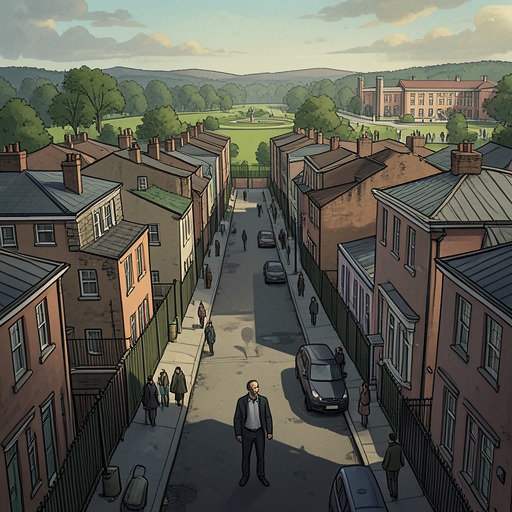
The house is a semi-detached home on Melkweg, in a development marketed two years earlier as a cluster of “planet villas.” The brochure promised Russian, Etruscan, Italian, and Egyptian façades, but Peter sees no trace of the Italian or Egyptian styles: to him, the buildings look like concrete blocks dropped into a sandy wasteland. When the couple moves in, the street has no paving stones. Rain and the repeated passage of removal vehicles have sunk the steel road plates into mud, and the hired van gets stuck more than once before reaching their house.
Peter and Eva had deliberately chosen the address for the life they imagined their child would have there. Their semi-detached house looked onto a vacant plot intended to become Mercuriusplein, with a football field, halfpipe, climbing tower, and sandpit. The nursery was around the corner, the school within walking distance, and so was the supermarket. Peter pictured their daughter riding her bicycle to school and playing with friends on the square. The location promised convenience and a peaceful childhood amid a mix of terraced houses, semi-detached villas, and detached houses.
Moving In After Loss
The move goes ahead not because Peter and Eva have recovered their enthusiasm, but because they cannot sell the house. Three days after Eva gives birth to Lieve, Peter asks the estate agent to put Melkweg 1 back on the market. A year and a half earlier, demand had exceeded supply and the couple had obtained the home by lottery, which they took as a good omen. Now, the agent explains, prospective buyers are staying put or renting while they wait for the economy to improve. Peter and Eva have little choice but to move in and leave their rented city flat behind.
The rooms preserve the plans they had made before Lieve’s death. Eva has not visited the house for more than six months, and neither family nor friends have been shown its plans or followed its construction. Peter has laid broad planks of antique-oak-look laminate and finished them in whitewash, as Eva once wanted. The kitchen is strand-white, chosen together while Lieve was still in Eva’s womb; they had planned for a microwave to warm bottles and rejected a boiling-water tap because a toddler might burn her hands. The room beneath the large tilt window, once intended as a nursery, has become Peter’s bright, spacious computer room, with ample cupboards. He has painted the walls pebble-grey, the frames shell-white, and laid Portuguese bluestone tiles in the hall and kitchen. He works evenings and weekends, like an ant, trying to make Eva’s dream house into something he can still give her.
Domestic Strain and New Projects
On moving day, Eva arrives close to darkness while Peter and her brother-in-law Edward are still assembling the household. Peter has the radio playing loudly; Eva pulls its plug, and Mick Jagger’s singing stops abruptly. Their first evening in the new home is marked less by reunion than by fatigue and distance. After eating takeaway Chinese food, Eva says she needs to sleep. Peter hears her move upstairs and, left alone with the empty plastic containers on the coffee table, throws them one by one against the pebble-grey wall. Orange sauce runs down the surface he had carefully finished.
Peter’s response to the house’s emptiness is repeatedly to start another project. He tears up a therapy affirmation and looks at the home as a bare symbol of grief, then imagines roses against the wall, a green lawn, terracotta pots full of flowers, and a fire pit or Spanish barbecue. Making plans helps him feel better: even if the nest remains empty, there is something left to build. The garden becomes a particularly tangible version of this effort. After two weeks of work, it has a vivid green lawn kept alive by a sprinkler system. During an exceptionally hot spell, Peter watches children play in the street while their parents complain that their new lawns are drying out; his own grass remains green partly because no children’s feet are trampling it. The contrast makes the immaculate garden both an achievement and a reminder of the child it was meant to welcome.
The house also hosts the couple’s daily conflicts. When Peter tells Eva that he has stopped seeing Hetty Vos, Eva responds with silence and spends the day carrying groceries through the house without speaking to him. He takes the bags, puts away the food, and prepares sauces, hoping she will confront him directly; instead, he experiences her prolonged silence as a familiar way of making him yield. That evening, their home is supposed to welcome Rebecca and Steef for a barbecue. Peter prepares the grill in the back garden while the surrounding families eat behind their fences. Rebecca and Steef arrive with tequila and limes, and their sleeping son, Sem, is parked in the shade. The gathering brings friends into the house just as tension between its owners has become difficult to ignore.
A Neighborhood and Home Reimagined
The contrast between the neighborhood’s planned sociability and Peter’s experience of isolation recurs. At a residents’ gathering across the street, Rebecca receives guests and Eva comes to the doorway in a red dress, asking Peter what he thinks of her appearance. The scene briefly recalls the couple’s ability to inhabit the neighborhood’s social life. But for Peter, parties are difficult: he describes himself as a shy journalist who finds it hard to start casual conversations, and he watches the gathering from the garden rather than joining it easily. The carefully arranged lawns, new homes, and outdoor gatherings do not guarantee a sense of belonging.
In another moment, Eva argues that moving forward cannot mean returning to their old, bourgeois patterns. She understands their suffering as having a reason and interprets Lieve’s death, and Rebecca and Steef’s arrival in their lives, as part of what they were meant to learn. Her outlook gives the couple’s losses a meaning that Peter does not comfortably share. The house is implicated in their disagreement: it embodies the conventional family future they had planned, while Eva insists that the pain has changed what that future can be.
The home also becomes a place of exposure and alarm. One night, after a young man repeatedly shouts Steef’s name and smashes the windshield of a car, Peter rushes downstairs and looks through the front door. Eva follows him, pulling her dress over her head as she comes down. Peter whispers for the light to remain off. The neighbors’ lights come on, but no one comes outside. Inside the house, the couple watch and wait rather than stepping into the street; Peter reasons that Steef, who is a police officer, will call the police himself. The scene turns the front door from a threshold into a barrier between the occupants and a disturbance they can hear but do not control.
From Shelter to Something to Escape
After visiting a shooting range, Peter returns to the house in a shaken state and begins to treat its history as evidence of a curse. He thinks that he has poured his energy and hope into a home that brings bad luck, connecting its foundations to the death of Lieve and to his belief that the new neighbors intend to destroy him and Eva. He generalizes from their particular home to the entire development: the planned neighborhood seems soulless, built on unstable ground, with no older houses or settled history to give it a life of its own. These judgments belong to Peter’s distressed perception rather than to an established account of the house’s powers or the neighbors’ intentions.
The future once represented by the house’s nursery and garden has, in Peter’s mind, become inseparable from Lieve’s death and the perceived lifelessness of his marriage. He imagines taking Eva away from the suburb and starting again in a quiet village, then recognizes that he is in a drug-induced comedown and that his thoughts may not be true even as they feel compelling. Unable to remain inside, he runs out into the light, takes his motorbike, and rides away from the manicured neighborhood and its model homes. Melkweg 1 thus ends this stretch of Peter’s story not as a secure domestic refuge, but as the physical center of memories, ambitions, and fears that he can no longer bear to inhabit.